About me
I am a postdoctoral researcher working with Prof. Aurore Loisy at the Institut de Recherche sur les Phénomènes Hors Équilibre (IRPHE), Aix-Marseille Université, CNRS. Previously, I completed my doctoral studies with Prof. Eva Kanso at the University of Southern California in 2025. I received my B.S. degree from Shanghai Jiao Tong University in 2019, where I worked with Prof. Hong Liu and Prof. Yang Xiang as an undergraduate research assistant at the J.C. Wu Center for Aerodynamics.
My CV can be found here: English CV / Chinese CV.
Research interest
My research aims to uncover the physical principles underlying collective intelligence. Animal groups display remarkable emergent behaviors that arise from local, decentralized interactions. In particular, bird flocks, fish schools, and insect swarms sense and respond both to their neighbors and to the surrounding flow field, exploiting fluid–structure interactions and social interactions to harvest energy and information—capabilities that remain beyond those of most engineered vehicles. By combining high-fidelity CFD, robophysical experiments, reduced-order modeling, and machine learning, I seek an integrated understanding of these autonomous behaviors in the context of unsteady fluid mechanics, sensorimotor control, and statistical physics. Ultimately, I aim to translate these insights into design principles for flow-adaptive autonomous robots.
Current Research
Autonomy in biological and engineered systems is rarely achieved by a single controller; instead, a hierarchy of coordinated controllers enables high‑level exploration and low‑level actuation. High control autonomy involves exploring the surrounding unknown environments of agents based on onboard sensing. These tasks can be achieved by either an individual agent or a group of cooperative agents.
For a single agent, I am specifically working on underwater navigation based on local flow sensing. This problem is tackled by data-driven methods, e.g., model-free reinforcement learning. Several scenarios are considered. In the first scenario, we studied the sensory control strategy of an agent following a hydrodynamic trail without any visual. The second scenario considered a weak swimmer utilizing the unsteady flow feature to swim against a strong adversial flow. The third scenario asked what information about neighboring fish can be decoded when fish are swimming in a school. We asked the following questions. (1) What flow property is the most effective sensory cue, whether it is velocity, pressure, or vorticity? (2) Which location is optimal for placing the sensors along the body of the swimmer? (3) Under which environments can the policies generalize and have a decent performance, and why?
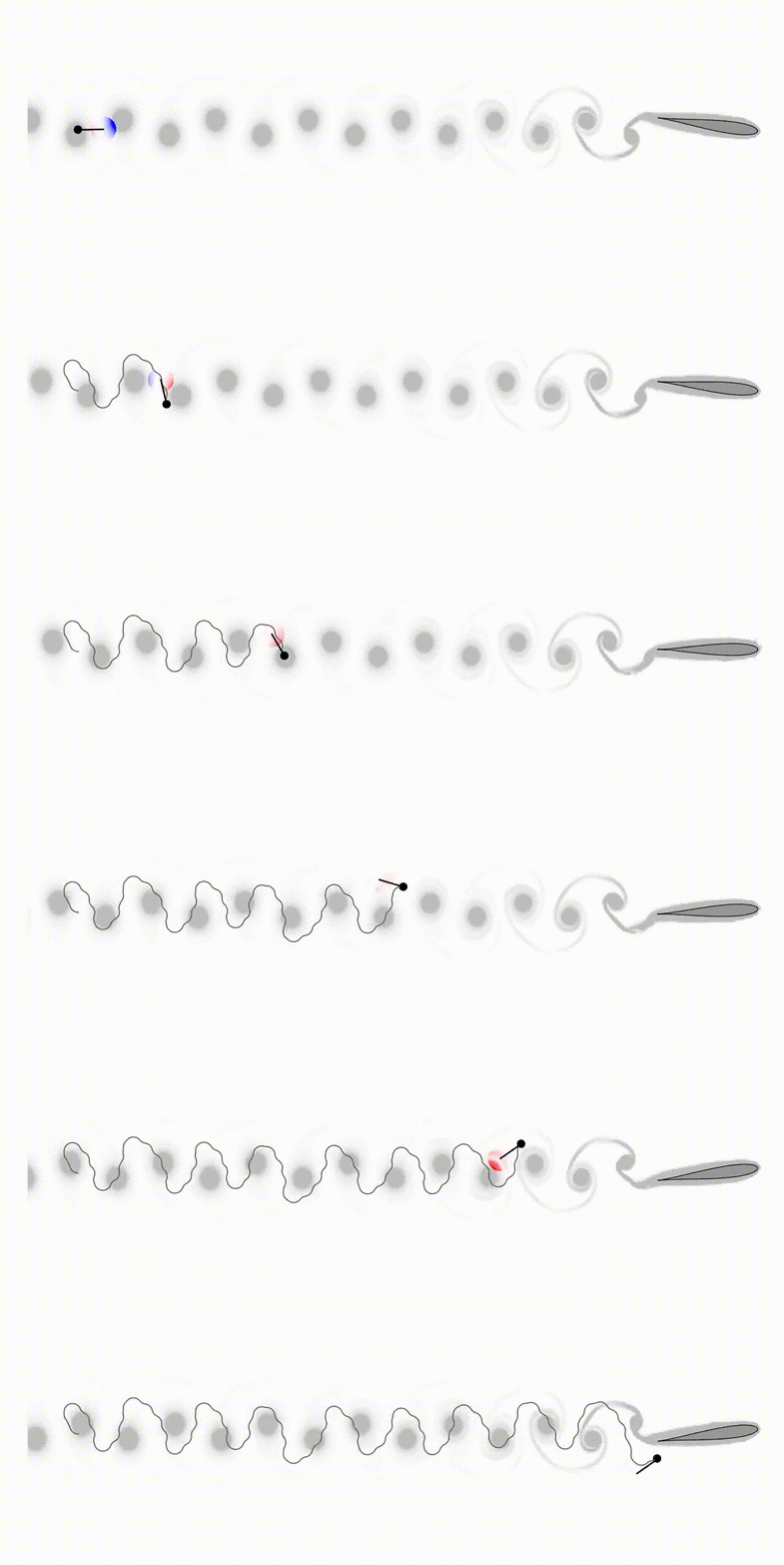
For multiple agents, different physics are dominant for the problem for different number of agents. When several fish are interacting in the near field, hydrodynamic interaction plays a crucial role in both maintaining social cohesion and achieving energetic benefit. Based on the existing literature of pairwise interaction, we asked the following questions. (1) How do the energetic benefits and school cohesion scale from pairwise interaction to more swimmers? (2) Whether we can predict the stable equilibrium of a follower swimmer given the flow field generated by a leader or a leading group? (3) How does the spatial pattern of swimmers influence the distribution of energy saving among swimmers?
For much larger schools, schooling fish, flocking birds, swarming insects, and even human crowds seem to follow a set of universal behavioral rules: attraction, alignment, and avoidance. We explore how emergent collective patterns change with the increasing number of agents. Using tools from statistical physics and information theory, we studied the following questions. (1) How does information and perturbation transfer through the school? (2) What are the differences and common properties between polarized schooling and rotationally ordered milling patterns? (3) How to derive a continuum description of active matter from local interaction rules?


At low-level autonomy, I solved fluid-structure interaction problems to optimize efficiency and/or force generation using both experimental and computational methods.
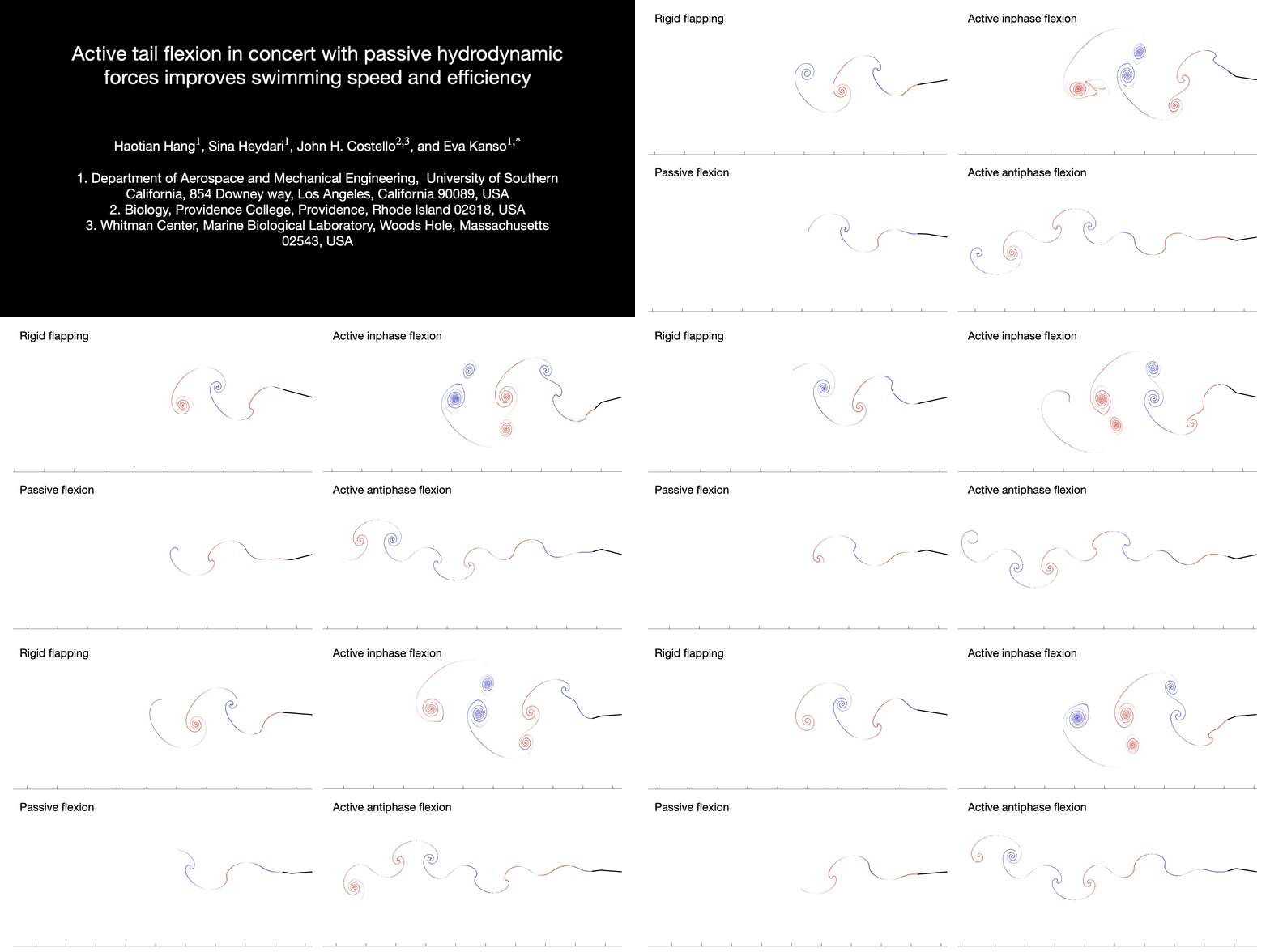
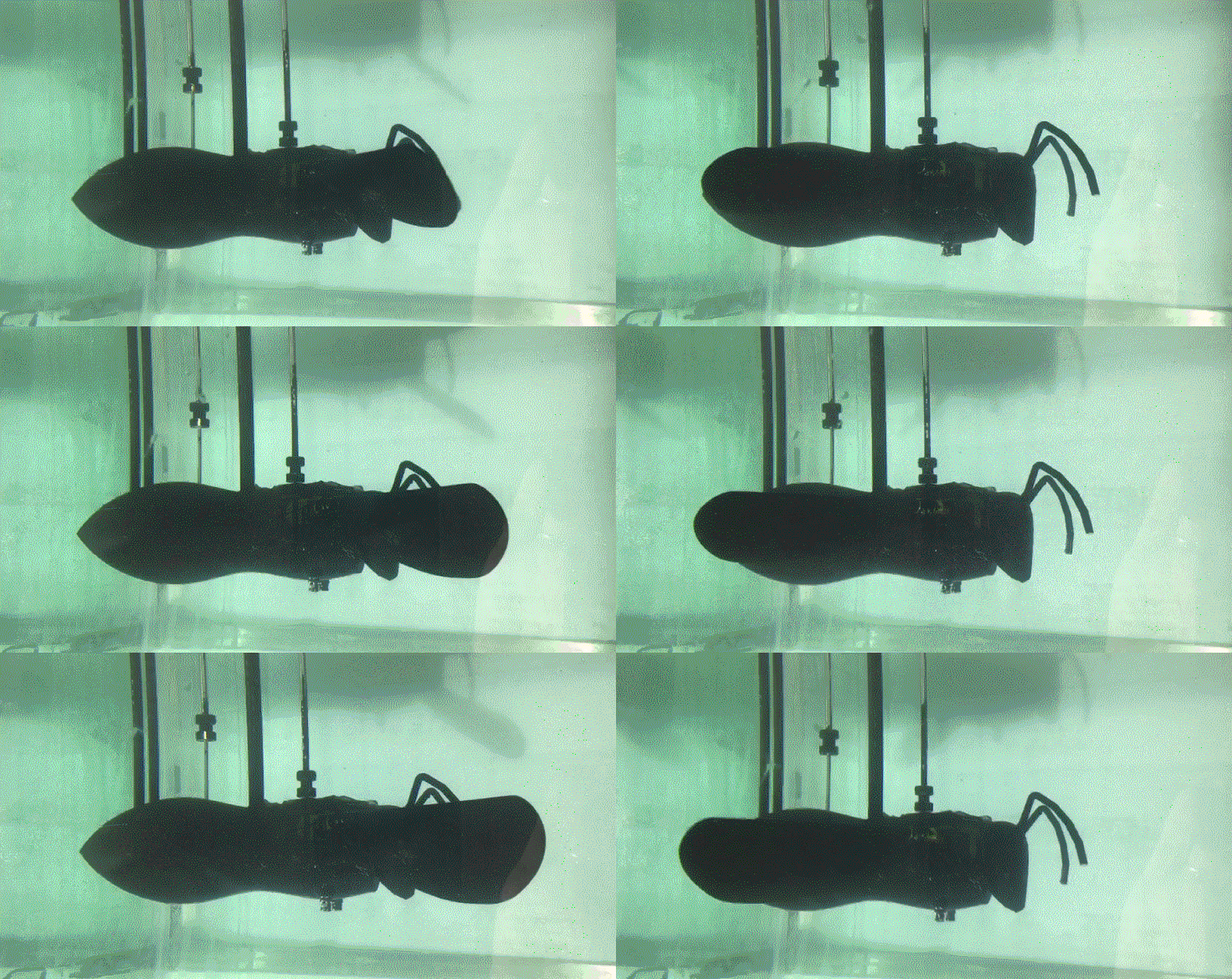
Interacting with fluid “in person”
I’ve also began training toward a private pilot at Santa Monica Flyers.